

What happened to EOS?
EOS no longer trades under that name. On 18 March 2025 the EOS Network Foundation announced that the network would be rebranded Vaulta and refocused on what it calls Web3 banking. Two months later, on 14 May 2025, the token swap opened: one EOS converts into one A, the new native token, with no fee and no slippage. The EOS ticker has been retired in favour of A.
Here is the part that trips people up: it was a rename, not a fork. No new chain was launched, no snapshot was taken, nothing was redenominated or diluted. The Antelope mainnet that ran as EOS is the same mainnet that runs as Vaulta today — same account names, same smart contracts, same block producers, same unbroken transaction history. Only the identity and the token symbol changed.
- Former name
- EOS
- New name
- Vaulta
- Former ticker
- EOS
- New ticker
- A
- Swap ratio
- 1 : 1
- Swap opened
- 14 May 2025
- Blockchain
- Antelope, unchanged
- New focus
- Web3 banking
Why EOS became Vaulta
EOS spent its first years selling itself as a general-purpose smart contract platform — a race it comprehensively lost. Vaulta is a much narrower bet: rather than hosting every kind of decentralized application, the network is being positioned as financial infrastructure, and the roadmap is organised around four pillars.
- Wealth management — on-chain custody, staking and yield products.
- Consumer payments — everyday transfers on a chain with sub-second blocks and negligible fees.
- Portfolio investment — tokenized assets and managed exposure.
- Insurance — risk products written as smart contracts.
These sit on a product stack the foundation calls BankingOS, guided by a banking advisory council recruited from regulated finance, with executives from ATB Financial, Systemic Trust and Tetra. Vaulta also plugs into exSat, a Bitcoin layer meant to bring BTC liquidity into that stack — the project's answer to how a mid-cap chain stays relevant to people who only hold Bitcoin. Whether any of it works is an open question. What is no longer in question is that the old EOS pitch has been abandoned.
If you held EOS on Binance, Binance.US, Crypto.com, Bitget or MEXC, the conversion was done for you and your balance already reads A. If you held it on Coinbase, it was not: Coinbase said it would not execute the migration on behalf of customers, so you have to withdraw and swap it yourself — as with any EOS sitting in your own wallet.
Sources: the Binance Square post on the rebrand and the official Vaulta token swap announcement.
How to swap EOS for Vaulta (A)
The swap is free, one-to-one and still open. What you have to do depends on where your coins are sitting.
- On an exchange that supported the migration — nothing to do. Binance, Binance.US, Crypto.com, Bitget and MEXC, among roughly twenty platforms coordinated with the foundation, reissued EOS balances as A automatically.
- On Coinbase, or anywhere that did not migrate — withdraw your EOS to a self-custodial wallet that supports the network, then swap it yourself. Coinbase stated plainly that it would not convert the asset for its customers.
- In your own wallet — use the official swap portal on vaulta.com. Advanced users can also send EOS on-chain straight to the
core.vaultaaccount, which is the swap contract itself. - Staked EOS, or tokens in REX — leave them if you want to; they keep earning. When you unstake through
core.vaulta, what comes out is A.
One timing detail matters. The portal was bi-directional for its first four months, so until roughly September 2025 you could convert A back into EOS. That window has closed: the swap is now one-way, EOS to A only.
There is no deadline, but waiting costs you. Un-swapped EOS stays on-chain and still moves, yet every wallet, app and exchange that retires the old ticker thins its liquidity a little further. And treat any “swap portal” you did not reach from vaulta.com as hostile — the only contract involved is core.vaulta.
Why buy EOS — now Vaulta (A)?
The rest of this page was written during the EOS era and is kept as a record of how the network got here. The partnerships, projects and figures below belong to that period — the chain they run on is the one now called Vaulta, and the token they refer to as EOS is the one now ticking as A.
Thanks to its design, EOS is disrupting several sectors of the economy, including social media, games and cryptocurrency trading platforms, in other words decentralized finance (DEFI). We believe that EOS is a good bet for the future and we are not the only ones since several investors with very impressive track records are investing in the EOS ecosystem. For example, Mike Novogratz, head of the Galaxy Digital investment fund, Jihan Wu, CEO of Bitmain, and Peter Thiel, co-founder of PayPal. At the start of 2020, EOS took another important step with the official release of version 2.0 of its blockchain software EOS.IO supposed to be 16 times faster thanks in particular to a new WebAssembly engine (WASM) developed in-house. But that's not all, this new version adds WebAuthn support that will allow users to authenticate more easily directly via the browser and, last but very promising for blockchain developers, the company made available an Integrated Development Environment (IDE) to allow developers to more easily and quickly start a new blockchain project. At the end of 2020 the project was in the spotlight as Block.one (B1) and Google Cloud Platform (GCP) officially announced a strategic partnership. Google Cloud Platform has become a new block producer candidate of the EOS network, which with its powerful fiber optic network and global coverage will allow the EOS network to continue to move forward both technically and commercially. Indeed with this partnership EOS has gained recognition from the biggest name in the tech world. More good news followed on the same day: Block.one announced the arrival of a big name in finance, Marty Chavez, former CIO and CFO of the famous American bank Goldman Sachs, as chairman of its board. A few days later, the EOS ecosystem received another important piece of good news: one of the largest cryptocurrency exchanges in the world, Bitfinex, announced the release of its decentralized exchange built on EOS. This exchange called Eosfinex will bring liquidity to the EOS ecosystem since there is a liquidity bridge between Bitfinex and Eosfinex. In addition, this exchange will allow saturated blockchains such as Bitcoin and Ethereum to be scaled since these two assets are available as wrapped tokens. Still not convinced to buy EOS? We recommend that you take a closer look at the growing ecosystem below.
How to buy EOS / Vaulta A? (credit card or transfer)
Watch the ticker before you deposit. What you are buying today is A, not EOS: Binance, Binance.US, OKX, Crypto.com, Bitget and MEXC list the rebranded token, while some platforms still quote the old EOS symbol or have dropped it altogether. Check which one an exchange trades before you send it money. Everything else about the process is unchanged.
To buy EOS (EOS), the best option is to go through Coinbase or Bitpanda and make a deposit in fiat currency (Euro, Dollar, Pound...) by credit card or bank transfer. It is best to fund your account by bank transfer, as the fees are lower than with a credit card. If you only want to buy a small amount of EOS, a credit card is fine because it is simple and fast, but if you have a lot of money to invest in crypto, you should use a bank transfer from the start. Many people would also like to use PayPal to buy EOS, but we do not recommend it: few reputable platforms support this payment method and PayPal fees are high compared to a credit card or bank transfer. On the other hand, Coinbase does let you sell your EOS and receive the money in your PayPal account.
EOS: Official websites
Start with vaulta.com, which is where the rebrand, the roadmap and the official EOS → A swap portal now live. The older EOS domains below still resolve and remain useful for chain data.
The number of sites linked to the EOS blockchain quickly became impressive, as each block producer on the network (the transaction validators) develops tools to support the ecosystem. Below is a list of official links related to the EOS blockchain and its block producers.
EOS: Ecosystem
In just a few months EOS has become the most widely used platform for decentralized applications. Indeed, EOS easily dethroned Ethereum in terms of number of applications, and especially in number of active users and transactions. And it was predictable because EOS was designed to execute a very large number of transactions per second and it is very fast (one block every 0.5 seconds).
EOS: Decentralized finance (DEFI)
After the big explosion of decentralized finance on Ethereum in 2020, developers realized that they could do the same on EOS and even do much better thanks to the speed and zero transaction fees of the EOSIO blockchain software. Some DEFI projects on EOS even started well before the DEFI trend of summer 2020, for example Newdex (NDX), Vigor (VIG) or Chintai (CHEX). Then in the summer we saw many promising new projects appear such as Defibox (BOX), Defis Network (DFS), Your Fancy Carp (YFC), DMD Finance (DMD), Coral Finance (CRL) and many more... All of those projects are easily tradable against EOS on the Newdex decentralized exchange or on the Defibox and Defis Network decentralized swap applications.
EOS: Video games
In the future of video games, the player will be king: players will be able to accumulate rewards during their games and earn medals or points that are recorded on the blockchain and ultimately have a market value. Yes, they will be able to resell them for fiat currency or exchange them for items in another game. Can you imagine the potential? This is completely new in the world of video games and we believe that when players understand the value of the blockchain for saving player history, then EOS will simply become a reference cryptocurrency and the price of EOS will blaze like never before. And why not imagine a day when all of our favorite games such as Fortnite, Minecraft or even Warcraft would be on the EOS blockchain. This is exactly what the Ultra (UOS) and WAX projects offer, which are blockchains developed from the EOSIO software.
EOS: Casino and online betting
Here we are talking about everything that revolves around online gambling, casino games, card games, online betting… And in the EOS ecosystem there is no shortage of projects of this kind: users have plenty of choice and quality tends to rise with competition. Put yourself in the shoes of a user on an online betting site: you bet 5 dollars on a game of chance and want to know your result immediately. This is exactly what EOS betting dapps deliver, and if you have never tried one, you will be pleasantly surprised by the user experience. And this was only the beginning, as many more interesting projects entered the online gaming market in 2019 and 2020. EOSBet, for example, was one of the first decentralized gambling applications to obtain an official license from a government. You can also place sports bets with Sportbet (SBET). Eventually, the user experience will be so good that players will not even realize they are using a blockchain, and yet it will be very practical for them: they will have greater control of their credits (tokens), and transparency, and therefore trust, will be guaranteed.
EOS: Sidechain (other EOSIO blockchains)
As discussed previously there are other blockchains derived from the original EOSIO software built by the Block.one company. Since the software code is open source, other projects use it as a basis to develop new blockchains. We call them sidechains or sisterchains, but they are in fact similar to forks, like Bitcoin Cash or Litecoin are to Bitcoin. So there are Ultra and WAX in the world of gaming and there is also another very interesting project but very little known to the general public, this project is called Telos and its developers are building very interesting new features such as support for the EVM (Ethereum Virtual Machine) directly in Telos, which will allow Ethereum projects to migrate their smart contracts to the Telos blockchain and take advantage of its scalability, speed and zero transaction fees. But that's not all, the Telos team is also working on T-Bond-inspired DEFI projects with an NFT (Non-Fungible Token) trading platform that adds a 1-to-5-year lock-up period before the token can be unlocked.
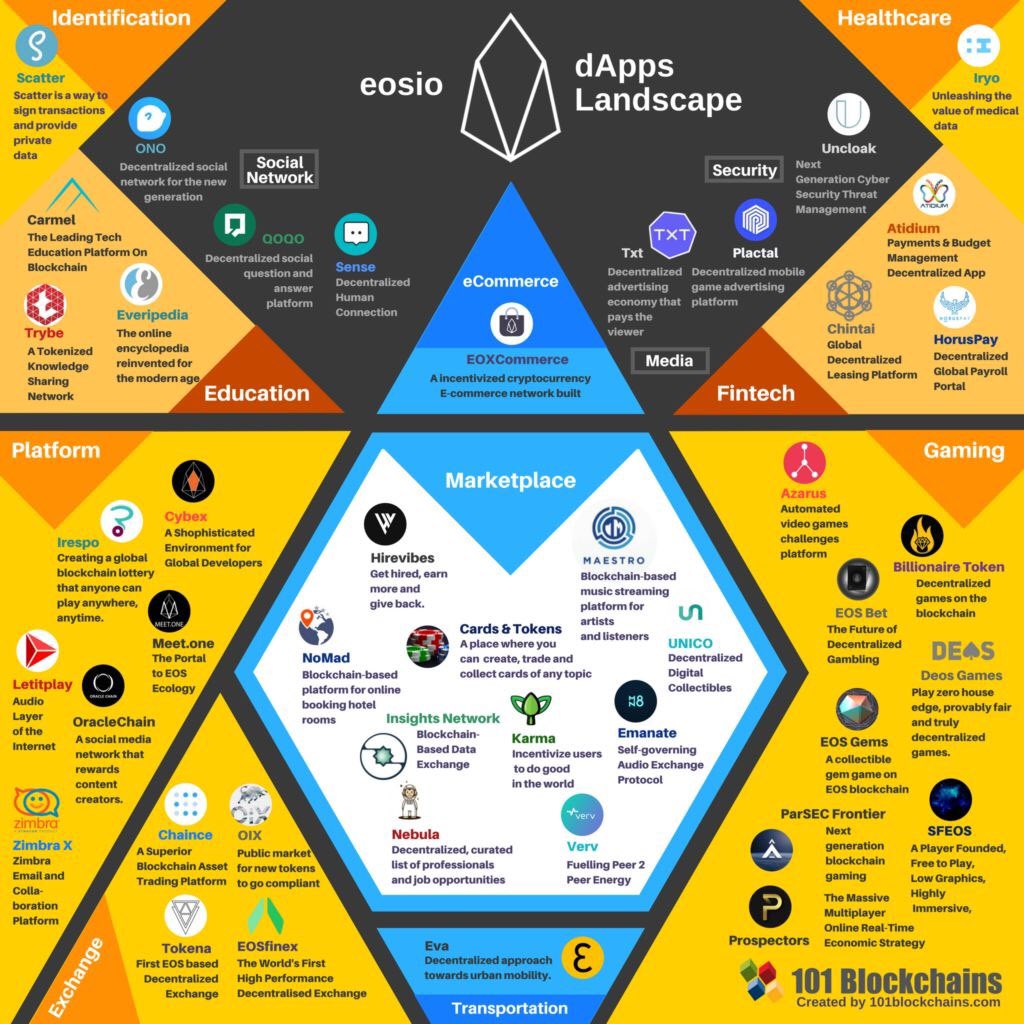
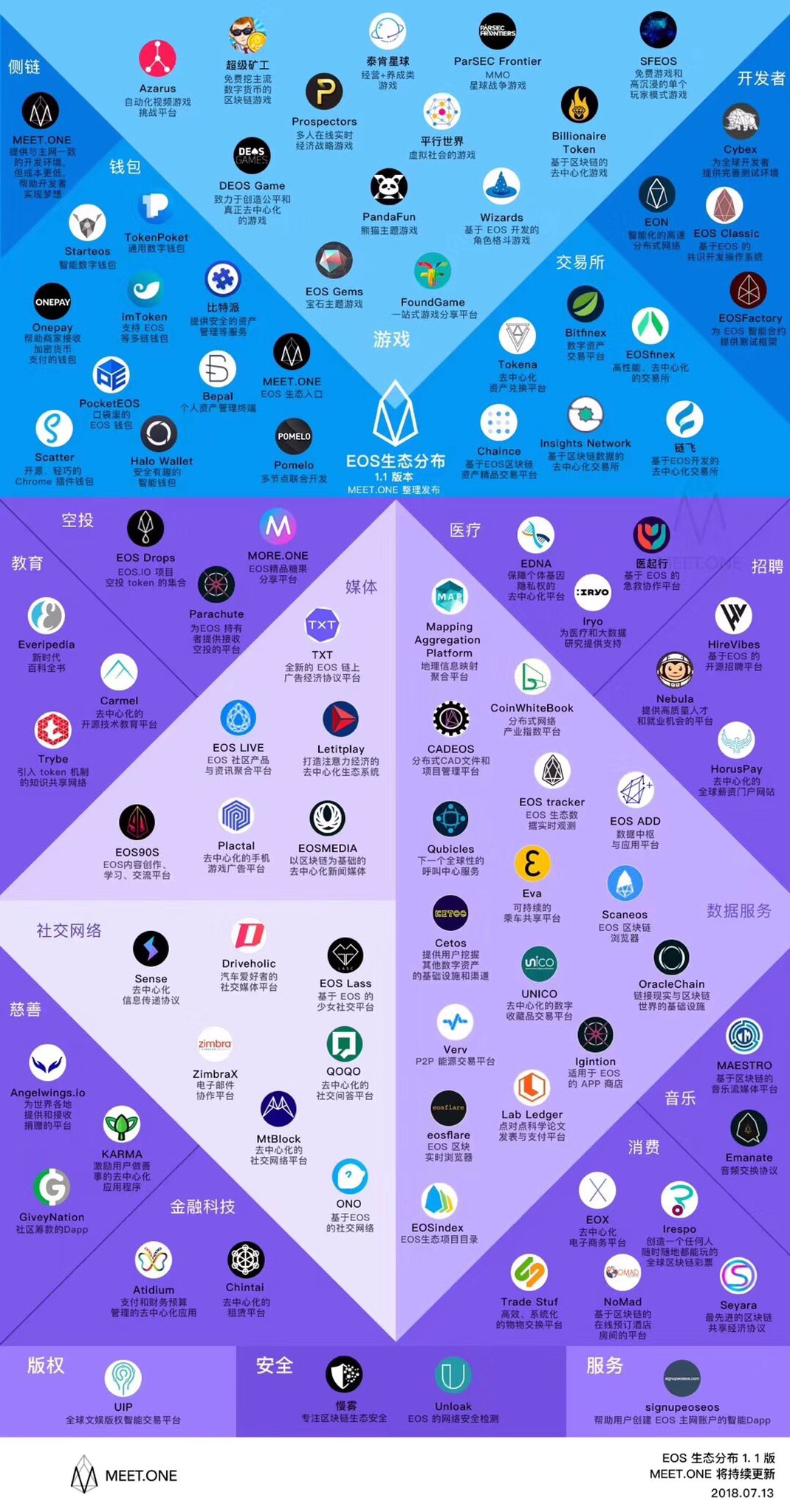
EOS: List of EOS Apps (DAPPS)
Many decentralized applications (DAPPS) appeared in the EOS ecosystem in just a few months.
Below are some illustrations showing the multitude and diversity of projects built around EOS.

EOS: Social Networks
To connect with the community, here are the most important forums and social networks for EOS. They will help you follow the news, discover new dapps and form your own opinion on this blockchain.
EOS FAQ: the Vaulta rebrand, answered
The questions people actually type into a search box after discovering that their EOS has turned into something called A.
What happened to EOS?
EOS was renamed. On 18 March 2025 the EOS Network Foundation announced that the network would become Vaulta and refocus on Web3 banking, and on 14 May 2025 the token swap opened: one EOS converts into one A, the new native token, with no fee and no slippage. The EOS ticker has been retired in favour of A.
It was a rename, not a fork. No new chain was launched and no snapshot was taken — the Antelope mainnet that ran as EOS is the same mainnet running as Vaulta today.
What happened to EOS Crypto?
The EOS token itself was replaced one-for-one by A. Around twenty exchanges coordinated with the foundation, and platforms such as Binance, Binance.US, Crypto.com, Bitget and MEXC reissued customer balances automatically — most people who held EOS on an exchange simply saw the ticker change.
Coinbase was a notable exception: it stated it would not execute the migration on behalf of customers. EOS held there, or in any self-custodial wallet, has to be swapped by its owner through the official Vaulta portal or the on-chain core.vaulta account. Balances were not diluted or redenominated — one EOS became exactly one A.
What is EOS now?
EOS is now Vaulta, a network positioned as Web3 banking infrastructure. It runs the same Antelope chain with the same sub-second blocks and negligible fees, but the roadmap is built around four pillars — wealth management, consumer payments, portfolio investment and insurance — delivered through a product stack the foundation calls BankingOS, with a banking advisory council drawn from firms such as ATB Financial, Systemic Trust and Tetra. Vaulta also integrates exSat to bring Bitcoin liquidity into that stack.
What is the new EOS ticker symbol?
A, usually written $A. It replaced EOS at a 1:1 ratio when the swap portal opened on 14 May 2025. Price sites and exchanges now list the asset as Vaulta (A); anything still quoted as EOS is the old, un-swapped token.
Is EOS a dead coin?
The EOS ticker is dead; the network is not. Blocks are still produced, block producers still validate, and the chain trades under the A ticker on major exchanges. What is fair to say is that the project never recovered the standing it had in 2018: A sits well outside the top 100 by market capitalisation and a long way below the old EOS all-time high. The honest read is a restart on a much narrower mission, not a return to form.
Does EOS crypto have a future?
That depends entirely on whether the Web3 banking thesis lands. In its favour: a fast, low-fee chain that already works, an EVM-compatible environment, the exSat Bitcoin integration, and a funded foundation with a clear mandate. Against it: EOS lost most of its developer mindshare years ago, regulated finance is a slow market to enter, and a new name does not by itself win back distribution. Treat it as a high-risk bet and do your own research before and after investing.
Do I still need to swap my EOS to A, and is there a deadline?
There is no deadline, but waiting costs you. The portal was bi-directional for its first four months, so until roughly September 2025 you could convert A back to EOS; since then it is one-way, EOS to A only. Un-swapped EOS stays on-chain and still moves, but every wallet, app and exchange that drops the old ticker thins its liquidity a little further.
Is Vaulta the same blockchain as EOS?
Yes. Vaulta is the same Antelope mainnet that ran as EOS, with the same account names, the same smart contracts, the same block producers and an unbroken transaction history. Nothing was forked, migrated or restarted — only the network identity and the token symbol changed.
Where can I buy Vaulta (A), formerly EOS?
On the major exchanges that supported the swap, including Binance, Binance.US, OKX, Crypto.com, Bitget and MEXC. The process is the same as for any other coin: open an account, pass identity verification, fund it by bank transfer (cheaper) or credit card (faster), then buy A. Availability of the A ticker still varies from one platform to another, so check the listing before you deposit.